
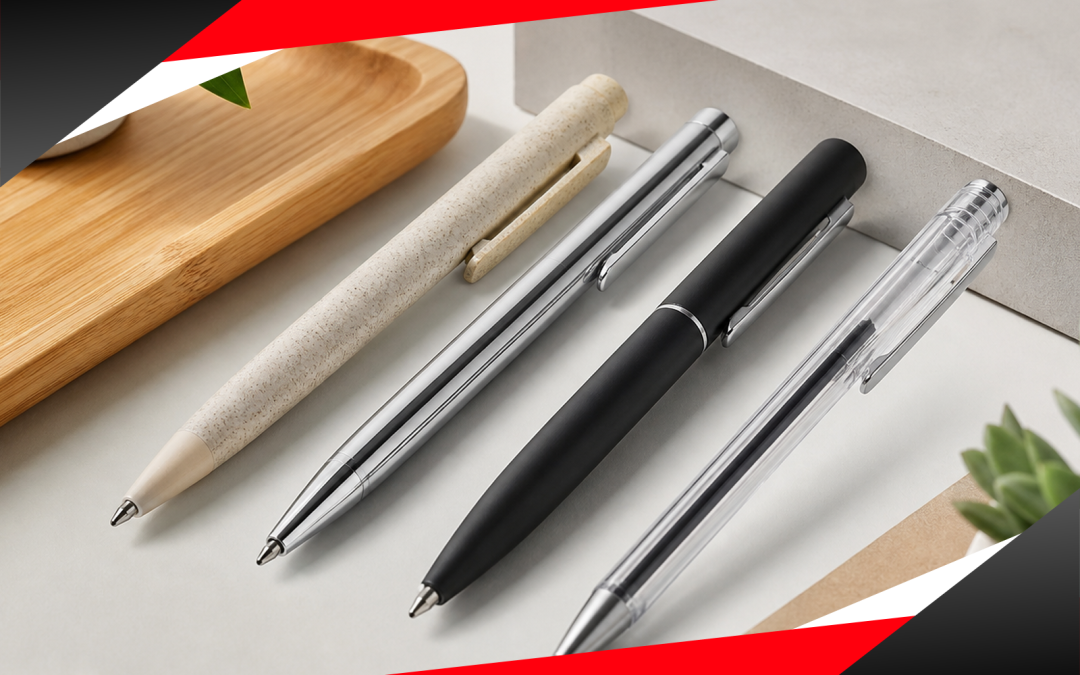
A pen can cost as little as ten cents to produce at volume, which is exactly why so many bulk orders go wrong. Promotional pens are the easiest branded item to order badly: the barrel feels hollow, the refill skips on the second page, the logo sits dark-on-dark where nobody can read it, and the whole run ends up in a drawer before the campaign has done anything for you.
This guide is for Australian marketers, office managers, event organisers and business owners buying custom pens in quantity. Rather than listing every variant on the market, it works through the decisions that actually determine whether a pen gets kept and used: who is receiving it, which material and ink suit that setting, how the branding will hold up, and where a slightly better pen earns its extra cost. For those also weighing up sustainability alongside durability, our eco-friendly promotional products guide covers how to choose materials and suppliers that align with greener business goals.
Start with the setting, not the spec sheet
The single most useful question before you compare products is where the pen will be handed over and what happens to it afterwards. One pen cannot serve a busy expo stand, a premium sales meeting and a staff onboarding pack, because the recipients behave completely differently in each case.
For conferences, trade shows, retail counters and other high-volume handouts, reach matters more than finish. You want a pen that writes reliably from the first click, is instantly recognisable across a crowded room and carries a simple mark that reads at arm’s length. Light weight helps here too, since these pens often travel in show bags or direct mail.
Client gifts, account-based campaigns and onboarding packs justify a different calculation. The recipient already has a relationship with you, so a pen with more weight, a better refill or a replaceable cartridge is more likely to stay on a desk and keep working for months. Internal office use and front-desk signing areas sit somewhere in between, where consistency is everything, because a pen that skips at the counter reflects on you every time someone signs. Matching the pen to the context this way is really the heart of choosing promotional products people actually keep, rather than items that end up in a drawer or bin.
Values-led campaigns need one extra decision. If sustainability is part of the message, choose a material you can describe accurately, and remember that a pen nobody uses is not a sustainable outcome regardless of what it is made from.
Plastic, metal, gel, eco and USB: the trade-offs that matter
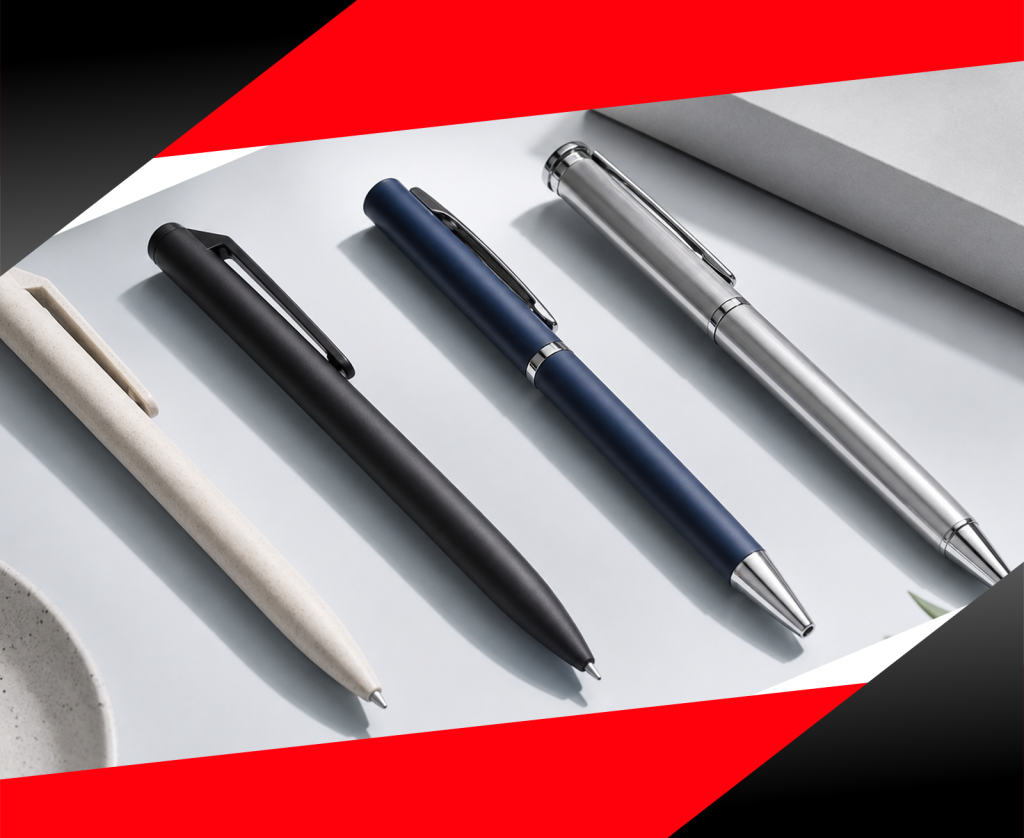
Plastic pens with logo branding remain the default for volume, and for good reason: they are inexpensive to produce in bulk, come in a wide range of barrel and trim colours, and are light enough to post. The trade-off is perceived value and lifespan, because plastic is generally less durable than metal or bamboo, so a flimsy barrel or a poor refill can cut short the number of impressions the pen ever generates. Printed plastic pens work best when you accept that and buy on reliability rather than novelty.
Metal pens, including aluminium and stainless steel, buy you durability and a premium feel. They resist wear, they can be engraved rather than printed, and the weight in the hand signals quality, which is why they suit executive gifts and higher-value promotions. There are two honest caveats: the unit cost is significantly higher, and some people simply prefer a lighter pen.
Gel pens are worth the extra thought when writing experience is part of the campaign. Gel uses pigment ink, which gives more saturated colour and better resistance to water and fading, so it suits conferences, training days and staff packs where people take real notes. The trade-off is drying time and the risk of smudging, particularly on glossy paper.
Eco options cover several very different things, from recycled plastic and recyclable components to bamboo, wheat straw and cardboard-style barrels. Bamboo is a fast-growing renewable material and tends to be durable, though it usually costs more than plastic and limits your colour and print options. Whichever you choose, describe it precisely rather than calling it impact-free, and make sure the pen is good enough that it actually gets used.
USB pens only earn their price when the storage function has a job to do, such as delivering resources at a training session or a sales pack. Bought without that purpose, they are an expensive novelty rather than a better pen. Across all these formats, choosing the right mix of custom branded promotional products comes down to matching material and function to how your audience will actually use the item.
Ink and writing feel beat clever styling
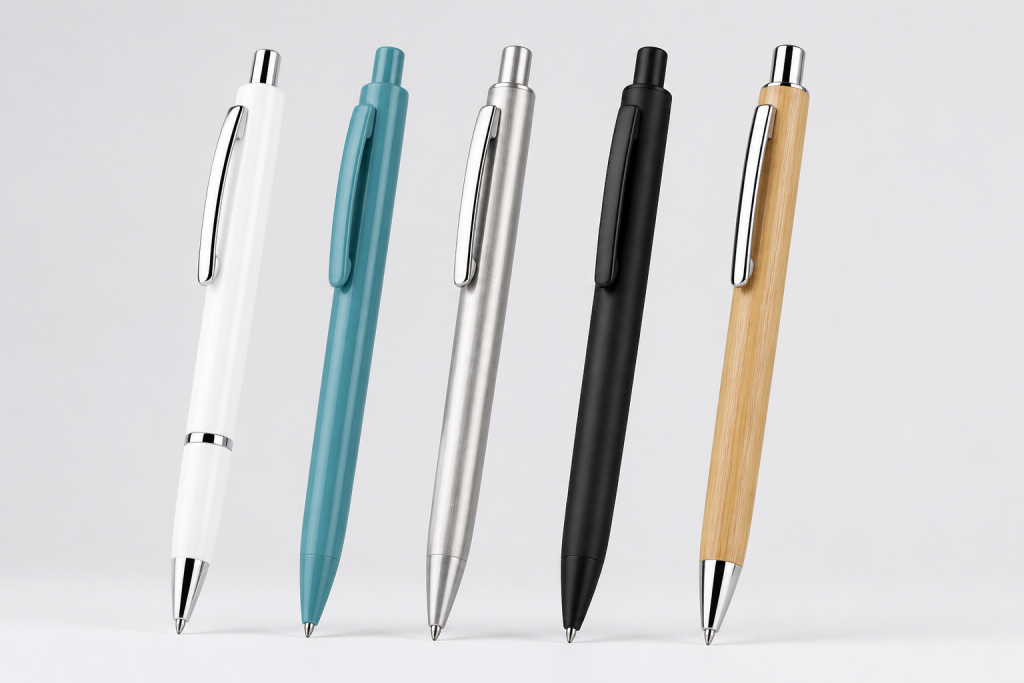
Ballpoints are the safe default for bulk orders, and the reason comes down to chemistry. Ballpoint ink is oil-based, so it dries quickly on the page, resists smudging, is too thick to bleed through paper and does not dry out when the tip is exposed to air. That last point is why retractable click and twist pens are almost always ballpoints, and it is exactly what you want in a pen that spends six months rattling around a bag.
Rollerball and gel pens flow more smoothly because the ink is water-based, so they need less pressure and lay down a cleaner line. The compromise is drying time: slower drying raises the smudging risk for left-handed writers and on coated or glossy event materials, and capped designs exist precisely because these inks dry out if left open. If note-taking quality is central to your campaign, that trade is worth making; if the pen is a general giveaway, it usually is not.
Ink colour is a smaller decision than it looks, but still worth making deliberately. Black reads as more formal and is the common choice for documents, while blue stands out on forms and handwritten notes and makes an original signature obvious. Pick based on where the pen will be used, not on what looks best in the product photo.
Above all, spend your attention on refill quality rather than unusual clips, shapes or mechanisms. People keep pens that start first time and write consistently, and they bin the ones that feel scratchy no matter how the barrel is styled. Because writing feel cannot be judged from an image, ask for a sample before committing to a large run.
Keep the logo readable for the life of the pen
A good pen still fails as a branded item if nobody can read the branding. The print area on a pen is small, curved and often only a few millimetres deep, so a detailed logo with fine text, thin strokes or multiple elements will lose definition the moment it is scaled down onto a slim barrel. Simplify before you order, because a clean wordmark, a single icon or a short URL usually works harder than a full lock-up crammed into the space.
It also pays to match the method to the artwork. Pad printing handles simple, one or two colour logos well and suits large runs, while full-colour or digital printing is the answer when the artwork genuinely needs multiple colours or a gradient. Engraving suits metal pens, where a laser-etched mark gives a clean, understated finish that cannot rub off or fade, which is why it fits executive gifts intended to last.
Contrast is the detail buyers most often miss. A dark logo on a dark barrel, or a pale mark on a light one, can look acceptable on screen and then disappear in real light on a curved surface. Choose barrel and print colours together and treat the proof as a genuine checkpoint: check size, placement, alignment, spelling and colour, and ask yourself whether the mark is still recognisable at the size it will actually be printed.
Run through this before you approve the order
Work through these eight points in order and the specification tends to write itself.
1. Name the campaign goal. Mass awareness, lead capture, client appreciation, staff use, event note-taking, retail counter utility and premium gifting all point to different pens.
2. Describe the recipient’s behaviour. Will they write daily, carry the pen, leave it on a desk, use a USB function, or judge it as part of a premium brand experience?
3. Set the budget by useful exposure, not unit price. A better or refillable pen that stays in use can deliver more brand exposure per dollar than the cheapest disposable option, but only where the audience justifies it, and for short-term mass reach the economical option is genuinely the right call.
4. Lock quantity and lead time early, allowing room for artwork, proofing, production and delivery before any event date.
5. Choose the pen type deliberately: printed plastic pens for reach, metal for longevity and perceived value, gel where writing feel matters, eco where the material supports a real message, and USB only for a genuine tech use case.
6. Check the artwork against the product, covering print area, logo complexity, barrel and print colour contrast, print method and ink colour.
7. Decide your sustainability position honestly. Recycled, recyclable, bamboo, wheat straw, cardboard-style and refillable options each carry different trade-offs, and each should be described as what it is.
8. Approve a physical sample or a proof before the full run, especially on large quantities, premium orders or detailed artwork.
Working through these steps also makes it easier to select promo products on a tight budget, since each decision is grounded in genuine exposure and use rather than guesswork. If you are still torn between two options, pick the one you would happily use yourself for a week. That test catches poor refills, awkward weight and unreadable logos faster than any spec comparison.