

A recycled tote that falls apart after two shopping trips does more harm to your brand, and arguably to the planet, than no giveaway at all. That is the trap with sustainable promotional products: they only work when they are useful enough to be kept and credible enough to stand behind. Choosing well is really a procurement and brand-fit decision, then, rather than a hunt for the greenest-sounding material.
This guide shows you how to shortlist merchandise that people actually use, how to test a supplier’s sustainability claims so you avoid greenwashing, and how to brief a supplier with clearer, evidence-based criteria. Along the way you will get the selection logic behind choosing the right branded merchandise, the trade-offs to weigh and the questions to ask before you place an order.
What makes sustainable promotional products genuinely sustainable
Sustainability is not a single material claim; it is the sum of the whole product decision. The material matters, of course, but so does how long the item lasts, how it is made, how it is packed, how far it travels and what happens to it once it is finished. Recycled content, organic fibres, renewable materials such as cork or bamboo, recyclable metals like aluminium and certified paper all reduce impact in the right context, yet none of them is automatically sustainable in every case.
Durability usually beats the material on the label. A well-made stainless steel bottle used daily for years is a better choice than a flimsy eco item that cracks and gets binned, because most of a product’s footprint is wasted the moment it is thrown away. Judge recyclability honestly, too: check whether the item can realistically be recycled in your recipients’ local kerbside system, and be wary of mixed materials that fuse metal, plastic and silicone together, since those are far harder to separate and dispose of. Where a supplier offers spare parts, replacement lids or a take-back route, that genuinely extends useful life.
Ethical sourcing belongs in the same judgement, not as an afterthought. If labour, factory safety or supply chain standards are unclear, the environmental story is weaker, which is why social compliance certification carries real weight. Finally, look at packaging and transport: ask for recycled or recyclable packaging, avoid individual plastic wrapping unless hygiene or protection demands it, consolidate shipments, and consider regional sourcing where it cuts unnecessary freight. Applying these same principles helps you choose must-have branded merch for 2025 that people actually keep and use.
Start with the audience and campaign goal before choosing the item
Before you open a single product catalogue, define who will receive the item, where they will use it and what problem it solves in their day. That order matters, because the most sustainable product is the one that gets kept and used rather than discarded. Match the item to the campaign objective as well: broad awareness campaigns often call for affordable everyday utility, whereas employee recognition, client gifting or a sustainability launch can justify fewer, higher-quality pieces.
Use recipient fit as a waste filter. If your audience will not carry, wear, drink from, write in or store the thing regularly, it is probably the wrong choice however impressive the material sounds. Brand fit matters just as much, so the product should make sense for your sector, values and audience expectations rather than feeling like a token green gesture bolted onto an unrelated campaign. Ordering fewer, better-targeted items almost always serves both budget and environmental intent better than maximising quantity, because unused stock and unwanted giveaways quietly undo everything you were trying to achieve. This is where the first common mistake shows up: choosing novelty over usefulness, especially at events where people are already drowning in freebies. Focusing instead on promotional products people actually keep ensures your investment continues to work long after the event is over.
Product categories worth shortlisting by use case
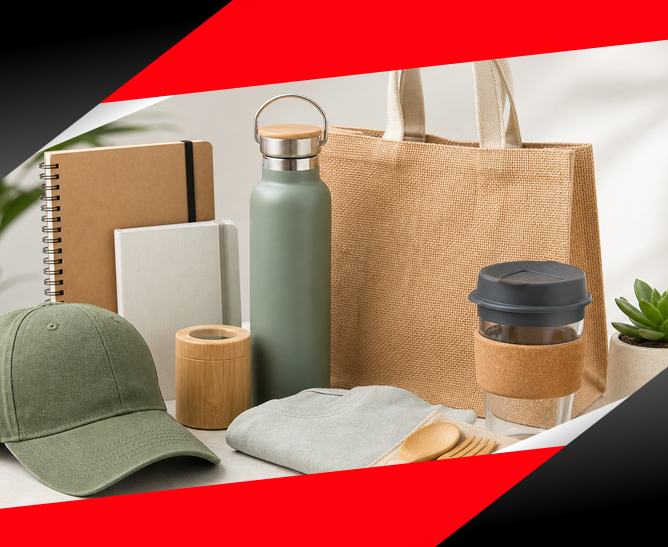
Everyday office items work when your audience still uses physical supplies. Recycled or FSC-certified notebooks, refillable pens such as rPET clicker pens, desk organisers and stationery all earn their place there; just avoid defaulting to pens if they will only be ignored. Drinkware is a strong performer where refills are convenient, so shortlist durable bottles, mugs and tumblers, then check material, lid quality, availability of spare parts, dishwasher suitability and whether recipients will genuinely reach for them daily.
Bags cover totes, backpacks, laptop bags, lunch bags and travel pouches, but strength, comfort and a real use case matter more than the label, since a reusable bag only helps if it replaces other bag use over time. For apparel, choose things people will actually wear, such as well-fitted tees, hoodies, caps or socks, and assess fibre choice, certification, size range, print durability and whether the branding is subtle enough for repeated wear. Event giveaways should stay practical, light and relevant to the event journey: reusable lanyards, badges, notebooks, useful travel accessories or consumables all beat cheap throwaways that become waste before the visitor reaches the car park. For higher-value gifts to clients, partners or standout employees, our branded merchandise range includes premium drinkware, quality bags, useful tech accessories, outdoor items or curated gift sets, ordered in fewer units and backed by stronger proof of responsible sourcing.
How to avoid greenwashing when assessing claims
Ask for the evidence behind every claim. If a supplier says recycled, find out what percentage of the item is recycled content, whether it is pre-consumer or post-consumer, which part of the product it applies to, and whether the claim covers the whole item or just one component. A bottle with a recycled lid and a virgin plastic body is not a recycled bottle.
Lean on recognised certifications rather than vague labels. FSC covers paper and wood; GOTS or the Organic Content Standard cover organic textiles; GRS or RCS verify recycled content; OEKO-TEX signals chemical safety; Fairtrade and recognised social compliance schemes cover labour standards; and B Corp status speaks to the supplier or manufacturer as a whole. A credible supplier should readily state material composition, country of origin, factory or sourcing standards, packaging details, branding method and any audit or certification documents on file. Then apply lifecycle thinking, comparing expected use, durability, repairability, transport distance, packaging and disposal instead of treating one material attribute as proof. Words like eco-friendly, green, natural, biodegradable and bamboo mean little on their own; biodegradable, for instance, often only holds under specific industrial conditions. Before ordering, ask: what is it made from, what proof supports the claim, how long should it last, can it be recycled or repaired, how is it packaged, where is it made, and what happens to unsold or spare stock?
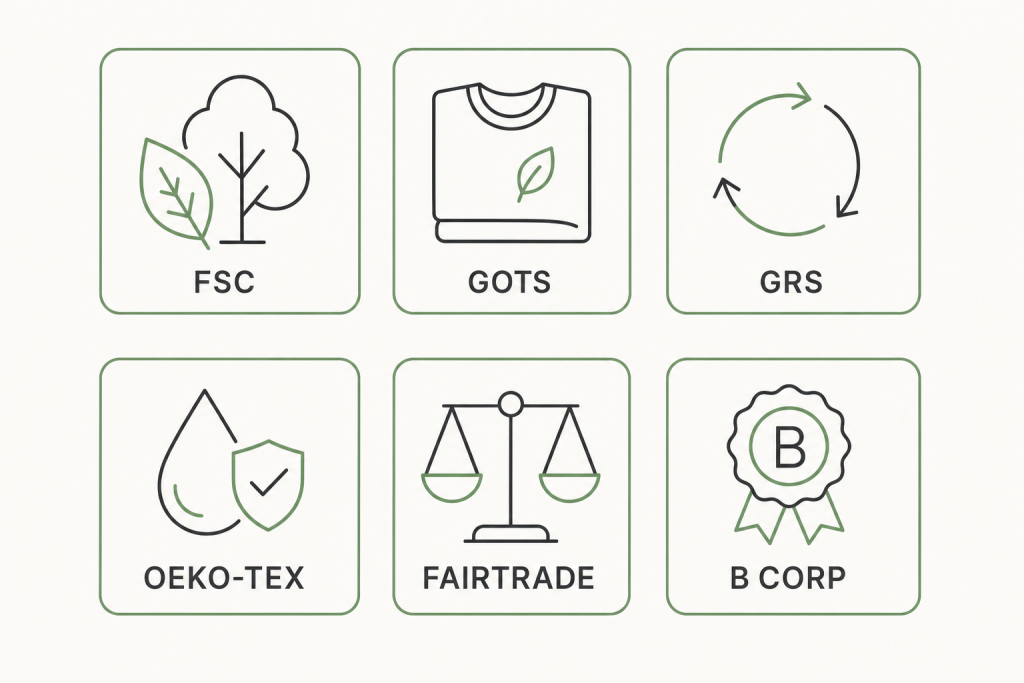
Recognised certifications to ask suppliers for when checking sustainability claims.
The practical buying checklist for procurement and marketing teams
Judge budget on total value, not unit price alone. Fold in artwork, set-up, sampling, packaging, delivery, storage and the wastage that comes from over-ordering, because a cheaper unit that ends up in a cupboard costs more in the end. Check minimum order quantities early and resist buying more than you need just to hit a lower per-unit rate, since leftover stock is both a budget problem and a sustainability one.
Test quality before you commit. Request samples where you can, handle them, check the functionality, and reject anything that will fail quickly or reflect badly on the brand. Choose a branding method that suits the material and its use life, such as engraving, embroidery, debossing or a durable print, and avoid decoration that makes the item harder to recycle or so conspicuous that people will not use it. Specify minimal, recycled, recyclable or plastic-free packaging where practical, and skip individual wrapping unless hygiene or protection genuinely requires it. Build in realistic lead times for sourcing, sampling and artwork approval so you can use lower-impact shipping rather than air freight, because rushed orders force compromises. Ask about end-of-life, too: can components be separated, does the supplier offer take-back or recycling guidance, and how should recipients dispose of the item? Watch for the recurring mistakes throughout, from assuming bamboo or recycled materials are automatically best, to ignoring quality, ordering too many units, choosing novelty over utility, and making claims the evidence cannot support.
Turn the criteria into a supplier brief
Put all of this to work in the brief you send suppliers. Ask them to come back with a small, justified shortlist rather than a sprawling catalogue, and require each option to be defended against use case, audience fit, sustainability evidence, cost and lead time. Give them what they need to do that well: the product’s purpose, the target recipient, the campaign date, a budget range, preferred and excluded materials, required certifications, packaging expectations, delivery location, branding method and end-of-life information.
Request a simple comparison table for the shortlist, covering material, recycled or certified content, durability, packaging, transport, minimum order quantity, unit cost, total cost, supporting proof documents and any trade-offs. That format makes weak claims obvious and strong ones easy to sign off. Keep one principle front of mind as you decide: the most credible choice is not the item with the greenest-sounding label, but the one recipients will genuinely use, backed by clear evidence and ordered in the right quantity.