
Running out of giveaways on day one of a three-day trade show is painful, but carting 400 untouched tote bags back to the office is worse, because you paid for every one of them. The question of how many promotional products to order sits somewhere between those two outcomes, and there’s no universal number: the right quantity depends on who receives the item, how it’s handed out, and what the budget per person allows.
This guide gives Australian buyers a way to estimate quantities for trade shows, conferences, staff rollouts, customer gifts and counter giveaways, so you can brief a supplier with real numbers rather than a vague “a few hundred, maybe”. It deals with demand planning on your side of the order, since getting the quantity right is central to stretching a tight promo budget across every item you order. Minimum order quantities, price breaks and production lead times all matter, of course, but they’re constraints you apply once you know roughly what you need, not the starting point.
Start with the purpose and who actually receives the item
Every quantity decision begins with one question: is this item going to anyone who walks past, or only to people who do something to earn it? A broad giveaway, where the goal is reach, needs high volume and a low unit cost, whereas a qualified lead gift is the opposite, with fewer units at a higher value released only when someone completes a conversation, a demo, a badge scan or an enquiry form. Mixing those two logics is how budgets get burned before lunch on the first morning.
Staff kits work on a different basis again, because you’re not estimating demand so much as counting heads, then adding spares for new starters, size swaps, replacements and the regional team that gets added to the rollout two weeks later. Customer thank-yous and mailouts follow a similar pattern but start from a cleaned recipient list rather than footfall, with a small reserve for returned parcels, address errors and the odd VIP who was left off the spreadsheet.
Counter stock in a store or showroom needs a defined campaign window, so estimate take-up over four weeks or a quarter rather than indefinitely, or you’ll keep reordering into a campaign nobody remembers. One factor cuts across all of these: distribution method changes demand sharply. Open tables and self-serve bowls empty two to three times faster than staff-assisted handouts, which means the same event with the same footfall can need wildly different quantities depending on how the item is presented, so matching the format to how you choose products people actually keep and use matters just as much as the quantity itself.
How many promotional products to order: a simple planning formula
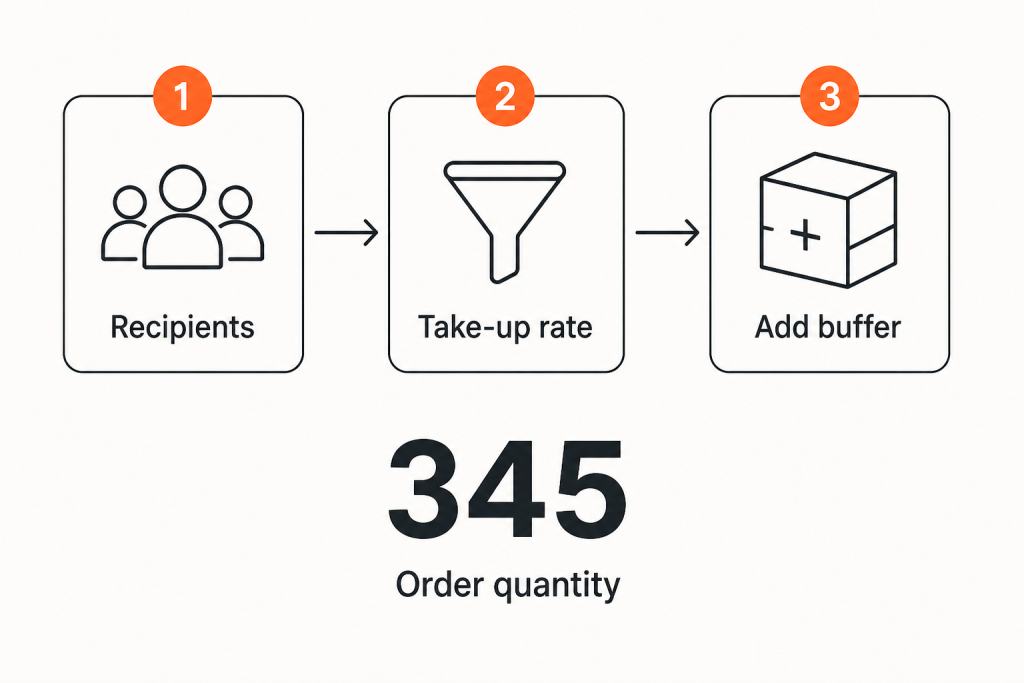
The core calculation is straightforward: expected recipients multiplied by likely take-up rate gives your base quantity, and a modest buffer on top gives your order quantity.
Expected recipients is whichever number genuinely describes your audience. For a conference that’s registered attendees; for a trade show it’s the slice of total attendance likely to reach your stand; for a staff rollout it’s confirmed headcount; for retail it’s average daily transactions across the campaign period; and for a mailout it’s the active customer list. Take-up rate then reflects how the item moves, so a free-for-all giveaway on an open table can approach the full number, while a gated or premium gift might only reach 10 to 20 per cent of visitors, because that’s roughly how many will stop for a real conversation.
Add 10 to 15 per cent on top for staff use, samples, damaged items, late guests, VIP requests and packing errors. A 400-person event with a 75 per cent take-up rate works out at 300 items plus a 45-item buffer, so around 345, while a 2,000-person expo at 25 per cent gives 500 plus 75, so around 575. Worth knowing: the industry works to a production variance of up to 10 per cent either way, so an order of 500 may arrive as 450 or 550. If an exact count matters, say so when you order.
Only now do supplier constraints enter the picture. If your estimate lands below the product’s minimum order quantity, the fix is to choose a lower-minimum product, pick something you can genuinely reuse later, or shift product tier. Buying 500 of something because that’s the minimum, when you need 180, is not a saving.
Quantity guidance for five common scenarios
Trade show booth: start from the share of total attendance likely to reach your stand, then adjust for position. A booth near a main entrance generates substantially more first impressions than a perimeter spot, so a prime position justifies pushing up to 50 to 75 per cent of expected footfall, while a back-corner stand at a large show may only need 25 per cent. Multiply for event duration as well, since three days is roughly three times a one-day event, and it pays to hold stock back and replenish each morning rather than putting everything out at once. Keep premium items gated behind a qualifying action.
Conference or seminar: if the item goes into a delegate bag or onto a seat, plan for one per registered attendee plus a small buffer for walk-ins and organisers. If attendees collect it from a sponsor table instead, you’re back to a take-up rate based on expected interactions, which is usually a fraction of the room.
Staff onboarding or uniform-adjacent kits: order for confirmed headcount plus spares, allowing for new starters over the next six to twelve months, size exchanges, lost or damaged items and teams in other states who get folded into the rollout later. Order a spread of sizes weighted to the middle, since large fits the most people.
Retail or counter giveaway: estimate daily transactions or visitor numbers across the campaign period, apply a take-up rate, then cap it. A gift with purchase is usually meant to feel limited, and a run under 100 keeps the offer scarce and the budget controlled.
Mailout or customer gift campaign: you already know the names, so skip the big generic buffer and work from the cleaned list, adding a small reserve for returned parcels, replacements and late additions.
Balance quantity, product tier and budget per person
The trade-off is simple to state and easy to get wrong: if the goal is reach, buy more of something cheaper, and if the goal is conversion or relationship-building, buy fewer of something better and be disciplined about who gets one. Most buyers end up with a higher quantity of low-cost gifts and a small number of high-end ones, and that split is usually right.
For events, a tiered split handles both at once. Put roughly 60 to 65 per cent of your total into budget items such as pens or stickers for casual visitors, 25 to 30 per cent into mid-tier items such as drinkware or notebooks for engaged prospects, and 5 to 10 per cent into premium stock held back for booked meetings, qualified leads and VIPs. Working through our promotional merchandise range makes it easier to find suitable options across all three tiers without overspending. The tiers let you be generous without being indiscriminate.
Use budget per person as your guardrail, because total budget divided by estimated recipients gives the maximum unit cost you can realistically carry. Then start subtracting, since setup fees, artwork, additional print colours, packaging, kitting and freight all come out of the same pot. An item priced attractively per unit can still blow the budget once each piece is individually bagged and shipped to three states.
Price breaks are worth chasing only under one condition. Nudging up to the next quantity tier can meaningfully lower the unit cost, and bulk pricing on some items drops 25 to 30 per cent between minimum-order and high-volume quantities, which is real money if the leftovers are usable. If the item carries a date, an event name, a seasonal offer or a campaign message that expires, the cheaper unit price is buying you storage, not value.
One larger order with a buffer, or smaller repeat runs?
A single larger order almost always wins on unit economics, because you pay the setup fee once, freight is cheaper per item and volume pricing applies. The cost is storage and leftover risk, which is a real cost even though it never appears on the invoice.
Go with one larger order when the product is evergreen, the logo and messaging will stay current, and the same stock can be drawn on across several events, offices or sales campaigns over a year. Plain branded pens, totes, drinkware and staff apparel usually qualify. Choose smaller repeat runs when the design is likely to change, the campaign is seasonal, the audience size is genuinely uncertain, or you simply have nowhere to put 2,000 units.
Timing decides whether the repeat-order option exists at all. Standard catalogue orders typically need three to four weeks, and larger or fully custom runs six weeks or more once artwork approval, production, decoration and delivery are counted, so if your next activation is five weeks out, reordering mid-campaign is not a safety net.
Before you commit, decide what happens to anything left over: carry it to the next event, add it to follow-up packs for prospects you met, hold it for new staff, keep it for sales visits, or use it as prizes. If none of those apply honestly, reduce the quantity or pick a different product.
What to send us for a quantity recommendation that holds up
The fastest way to get a usable recommendation is to give Get Branded the inputs behind your estimate, not just a number. Include the event or campaign date and delivery location, the expected footfall or recipient list size, and whether that figure is confirmed or an estimate, because the two lead to different buffers.
Spell out the distribution rules too: self-serve from a table, handed out by staff, gated behind an enquiry or badge scan, included in delegate bags, mailed to named customers, or issued to employees. Add your budget per person or total budget, the product type and quality level you have in mind, and whether items need individual packaging, kitting or separate delivery addresses. Then say plainly whether leftovers can be reused at future events, for onboarding, on sales visits or as customer thank-yous, since that single answer determines whether chasing a price break makes sense or just fills a cupboard.
The method, in short: start with recipients, apply a realistic take-up rate, add 10 to 15 per cent, divide the budget by recipients to sense-check the unit cost, and ask yourself what happens to the surplus. Briefing your merchandise supplier with that working shifts the conversation from guessing a number to matching it against product options, minimums and production timing.