

Promotional products ROI statistics are easy to distrust. A cost per impression under a cent and 85% recall sound persuasive, right up until you notice that most of those figures come from the people selling the products. So here is the honest answer before the detail: promotional products can deliver worthwhile ROI, but only when the item is genuinely useful, aimed at the right people and tied to something you can measure. Treat them as generic giveaways, or mistake possible impressions for actual profit, and they quietly drain your budget instead.
This article separates the awareness numbers from real financial return. It looks at what the headline statistics actually prove, what ROI means for different campaign goals, why some merchandise pays off while other batches gather dust, and a simple way to estimate, track and improve your return before you commit any spend. Understanding the real power of branded promotional products starts with knowing how to tell genuine value from clever marketing.
Promotional products ROI statistics: what the headline numbers really show
The figures marketers see most often are these: cost per impression can fall below $0.01, around 85% of consumers remember the advertiser on an item they received, and roughly 79% say they are more likely to do business with a brand after getting one. Alongside those sit retention claims, with a majority of people keeping promotional items for months or years, which means useful things like drinkware, tote bags and office accessories rack up thousands of impressions over their lifetime rather than the fleeting exposure of a single advert.
That is a genuinely encouraging picture, but recall and purchase intent are indicators of marketing value, not proof of revenue. Someone remembering your logo, or saying they would consider you, is a step in the right direction; it is not a sale. None of these numbers become ROI until they are linked to a measurable action.
There is also a source-quality caveat worth taking seriously. Much of the data behind what makes promotional products so effective comes from promotional product suppliers, trade bodies and press releases, so it carries an obvious commercial interest, and you should treat it as directional evidence rather than neutral proof. On balance, the data supports promotional products as a potentially efficient way to build awareness and engagement, but not as an automatic replacement for performance marketing you can already track to the dollar.

What ROI means for branded merchandise depends on the campaign goal
ROI is simply the attributable profit or value a campaign produces compared with everything it cost. The catch is that “value” looks different depending on what you set out to do, so there is no single universal number to chase. Direct sales ROI, lead generation, repeat engagement, event follow-up, customer retention, brand recall and cost per impression are all separate measures, and confusing them is where most disappointment starts.
Cost per impression is the clearest example. It is an efficiency metric that shows how cheaply you can put your brand in front of people, but it says nothing about whether that exposure changed anyone’s behaviour. Cheap views are not the same as profit.
That does not make non-sales metrics worthless. For a top-of-funnel campaign, brand recall, qualified conversations, booth visits, QR scans or email opt-ins may be exactly the right thing to measure. The discipline that matters is choosing one primary outcome before you buy anything, because choosing items people actually keep and use, the way you distribute them and the tracking you put in place all depend on whether your goal is awareness, leads, retention or conversion.
Why promotional products work when they do
Usefulness is the engine behind almost every positive statistic. An item people keep and use gets repeated chances to trigger recall and prompt action, whereas a novelty that goes in the bin generates one impression at most. As the industry’s own commentary puts it, the products that win are the ones people actually use, not just receive.
Relevance to the audience does most of the heavy lifting, so the item should fit the recipient’s role, environment, daily habits or the event they are attending, rather than simply carrying a logo and hoping. Quality reinforces this, because a well-made, functional product is far more likely to be kept and used, and it attaches a positive association to your brand every time it is picked up.
Timing matters just as much. A product tied to a specific moment, whether that is a meeting, a trade show, onboarding a new customer, a renewal point or a post-demo follow-up, has a clear job to do. And distribution is what turns all of this into return, because ROI from branded promotional marketing improves sharply when items reach the right people with an obvious next step, such as booking a demo, scanning a code, joining a mailing list or redeeming an offer.
When promotional products waste budget
The most common failure is the generic low-value item. If recipients do not want or use it, you lose the retention and repeated-exposure advantage that every impressive statistic depends on, and you are left paying for a moment of politeness. Poor targeting compounds the problem, because sending the same product to everyone dilutes relevance and spends money on people who were never going to buy, renew or influence a decision.
The quieter waste is a campaign with no follow-up mechanism. Merchandise without a QR code, landing page, redemption code, sales follow-up or CRM tag is almost impossible to connect to a business outcome, which leaves you guessing about whether it worked. Just as damaging is counting impressions as profit: thousands of potential views can make your cost per impression look excellent while contributing nothing you can bank, because return still depends on attributable action or clear strategic value.
Finally, watch the hidden costs, because the product price is only part of it. Artwork, set-up, shipping, storage, fulfilment, staff time and the inevitable wastage all belong in the campaign cost, and leaving them out is the easiest way to convince yourself a losing campaign was a winner.
A simple way to decide, measure and improve your return
Start with the two sides of the sum. Total campaign cost is products plus branding, delivery, fulfilment and staff time, while return is the attributable gross profit, pipeline value, retained revenue or agreed non-sales value the campaign produced. Get both honest and the maths does the arguing for you.
The part people skip is setting up tracking before distribution, not after. Give each campaign a way to identify itself: unique QR codes, a dedicated landing page, redemption codes, UTM links, event badge scans, a CRM campaign field or a segmented follow-up list. Without this, you cannot separate what the merchandise did from everything else in the market.
How you calculate value then follows the goal you chose earlier. For lead generation, work from the number of qualified leads, your conversion rate, average order value, gross margin and expected lifetime value, then set that against the full campaign cost. For retention or account-based campaigns, measure renewal rate, upsell conversations, meeting attendance, response rate or repeat purchase, ideally against a comparable group who did not receive the item. For awareness campaigns, use cost per retained item, cost per meaningful interaction, brand recall surveys or post-event engagement, but label these as campaign value rather than proven profit so nobody confuses the two.
That leaves a clean decision rule. Invest when the item matches the audience, the goal is specific, tracking is built in from the start, and the expected value compares well with your other channels. If any one of those is missing, do not sign it off. Redesign the campaign until it is there, or spend the money somewhere you can actually measure.
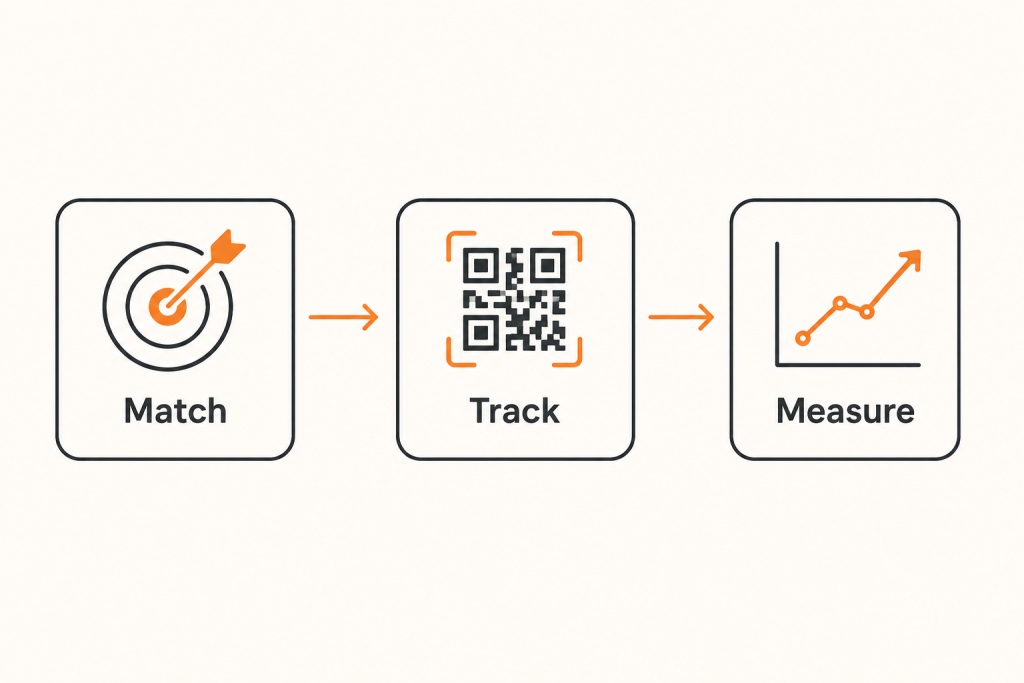
Three steps for promotional product ROI: match, track and measure.